The Leitner System:Spaced Repetition WithPaper Flashcards
· 4 min
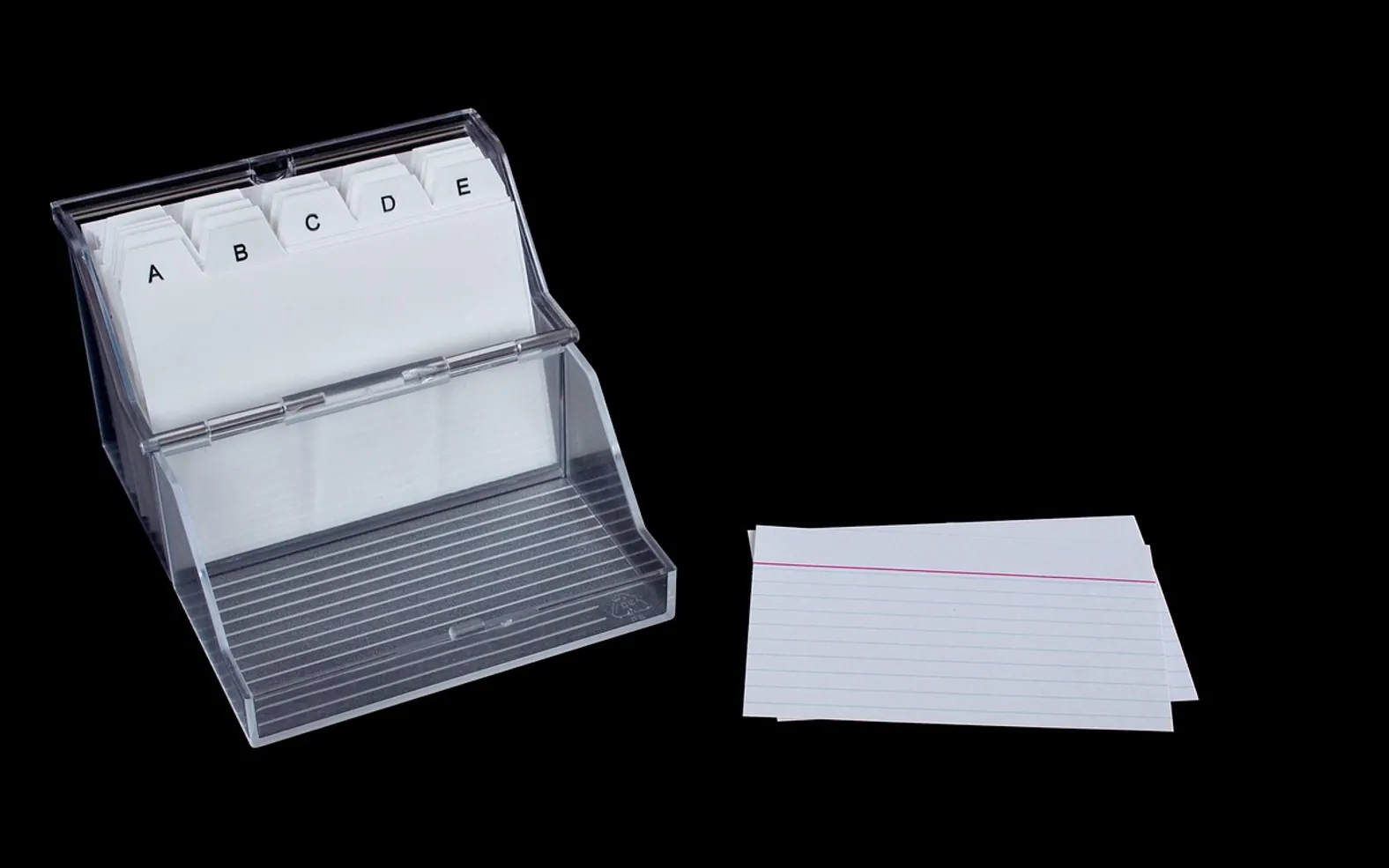
The Leitner system is a way of reviewing flashcards so that the cards you struggle with come up often and the ones you know well come up rarely. Cards live in a row of numbered boxes. Answer a card correctly and it moves one box along, where it waits longer before its next outing. Get it wrong and it goes straight back to box one. That single rule turns a shoebox of index cards into a working spaced repetition schedule.
Where the idea comes from
The method is named after Sebastian Leitner, a German science writer who described it in a popular book about learning in the early 1970s. It rests on a much older observation: memories fade fast after we first meet new information, and each successful review slows that fading. Hermann Ebbinghaus sketched the pattern in the nineteenth century as the forgetting curve. Leitner's contribution was practical. He handed ordinary learners a physical system that decides what to review next, so nobody has to track hundreds of cards in their head.
What you need
- A stack of index cards, or squares cut from stiff paper
- Five containers: small boxes, envelopes, or one long box split with cardboard dividers
- A pencil, so confusing cards can be tidied up later
- A simple calendar or a note on the fridge marking review days
How the Leitner system works, step by step
- Write the cards. One question per card, answer on the back. Keep both sides short.
- Start everything in box 1. New cards always enter at the beginning of the row.
- Review a box when it is due. Read the front, answer aloud or on scrap paper, then flip.
- Promote or demote. A correct answer moves the card up one box. A wrong answer, or one that needed a long hesitation, sends it back to box 1.
- Retire the graduates. A card that passes the last box can leave the rotation, or move to an archive you shuffle through every few months.
A spaced repetition schedule you can copy
The exact gaps are flexible. What matters is that each box waits longer than the one before it. Here is a straightforward pattern for five boxes:
| Box | Review it | What usually sits there |
|---|---|---|
| 1 | Every day | New cards and recent mistakes |
| 2 | Every second day | Cards answered correctly once |
| 3 | Twice a week | Cards that are settling in |
| 4 | Once a week | Fairly secure knowledge |
| 5 | Every two weeks | Cards you rarely miss |
If daily sessions feel like too much, stretch every gap a little. If box 1 keeps overflowing, add fewer new cards until it settles. The system bends to fit your week rather than the other way round.
Writing spaced repetition flashcards that work
Good cards make the whole routine smoother. A few principles help:
- One fact per card. If you could get half a card right, split it in two.
- Ask rather than state. A question on the front forces retrieval; a sentence with a gap often tests only recognition.
- Give context. For vocabulary, write a short example sentence instead of a lone word, so meaning and usage travel together.
- Reverse cards sparingly. Pairs that run in both directions help with languages, but they double the workload.
- Draw where words fail. A quick sketch of a map outline, a leaf shape or a chord diagram can be easier to recall than a description.
The real engine of the method is the moment you try to answer before flipping. That effort is called active recall, and the guide to studying by testing yourself covers ways to use it beyond cards.
What it suits, and what it does not
The Leitner system shines with material that breaks into small, checkable pieces: words and phrases, capital cities, historical dates, chemical symbols, keyboard shortcuts, the names of birds or wild flowers. It is a natural companion to learning a new language as an adult, where steady review of vocabulary matters far more than cramming.
It helps less with big, connected ideas such as the argument of a book or the shape of a lecture series. For those, a mind map for studying or a written summary usually works better, with a handful of cards to hold the key terms.
Paper boxes or an app?
Flashcard apps run the same principle automatically, working out each card's next review date for you. They are convenient for large decks and for studying on a phone. Paper has its own advantages: writing a card by hand is already a first review, the boxes sit on a shelf as a visible reminder, and nothing pings or distracts you once you sit down. Plenty of learners start on paper to get a feel for the rhythm, then decide whether software would save them time.
How many new cards per day?
Fewer than you might expect. Every new card creates future reviews, and the pile grows quickly. Start with a small, comfortable number and add more only when the daily box 1 session still feels light.
What if I miss a few days?
Nothing breaks. Clear box 1 first, then work forward through whatever is overdue. A missed day costs a little extra effort; abandoning the boxes altogether is the only real way to lose the benefit.




Tell us what you think.
We read every message.
Fridge sheet Plan your five boxes
Choose the day you start and how long each box waits. The calendar marks which boxes come out on which day; print it and tick them off as you go.
The default rhythm is the one from the table above: every day, every second day, twice a week, weekly, fortnightly. Box 1 starts on day one; every other box has its first session once its own gap has passed. Missed a day? Clear box 1 first, then catch up on the rest.